.jpg)
Updated: 16 September 2026
When employees use their own vehicles for work, mileage allowances help businesses reimburse them for the cost. For finance teams, getting these payments right means checking which journeys qualify, applying the correct rates and keeping clear records.
For the 2026/27 tax year, HMRC’s approved mileage rate for cars and vans is 55p per mile for the first 10,000 business miles and 25p thereafter. Different rules apply to company cars.
This guide explains how mileage allowances work and what employers and employees need to know.
Mileage Allowance Payments, or MAPs, are payments an employer makes when an employee uses their own vehicle for business journeys.
HMRC sets an approved amount that can be paid without an Income Tax charge. This is calculated using qualifying business mileage and the applicable rate for the vehicle.
Employers can choose their own reimbursement rates. HMRC’s rates determine the tax treatment; they do not require every employer to pay the same amount. HMRC mileage payment rules.
The following approved rates apply to employees using their own vehicles for qualifying business travel during the tax year running from 6 April 2026 to 5 April 2027.
The previous car and van rate of 45p for the first 10,000 miles applied through the 2025/26 tax year. Use the rate applicable to the year of travel when reviewing older claims. HMRC mileage rates.
For an employee driving 12,000 qualifying business miles in their own car during 2026/27:
This is the approved mileage amount, rather than an automatic payment from HMRC.
Changing cars does not restart the 10,000-mile threshold. Within the same employment, business miles in cars and vans are combined.
Motorcycle and bicycle mileage is calculated separately from car and van mileage. Personally owned electric and hybrid cars use the same approved rates as petrol and diesel cars. HMRC vehicle categories.
Qualifying journeys can include travel between workplaces in the same employment, visits to clients and travel to a temporary workplace where HMRC’s conditions are met.
Ordinary commuting between home and a permanent workplace does not normally qualify. Working from home for part of the week does not automatically make a journey to the regular office a business trip.
Temporary workplace rules need particular care. For example, a workplace generally stops qualifying as temporary where an employee expects to spend at least 40% of their working time there over a period exceeding 24 months. Other restrictions can also apply.
There is no general rule excluding a business journey simply because it is short. The purpose and circumstances of the journey determine its treatment. HMRC business travel guidance.
Approved mileage rates cover the cost of owning and running the employee’s vehicle, including fuel or electricity, servicing, repairs and vehicle tax.
Employees cannot claim separate tax relief for those same costs on top of mileage relief. For example, an employee using their own electric car cannot claim the approved mileage amount and then add separate electricity costs for the same travel. HMRC guidance on using your own vehicle.
An employee may qualify for Mileage Allowance Relief on the difference between the approved amount and their employer’s reimbursement.
For example, an employee drives 5,000 qualifying miles in 2026/27 and receives 35p per mile:
If the full deduction attracts relief at 20%, the tax saving would be £200. The employee does not receive the full £1,000 shortfall from HMRC.
Where payments exceed the approved amount, the excess is subject to Income Tax and relevant reporting requirements.
National Insurance has a separate calculation. For cars and vans, the qualifying mileage rate is 55p for all business miles in 2026/27, without the Income Tax reduction after 10,000 miles. Payroll teams should assess the two separately. HMRC rate-change guidance and National Insurance rules.
Employers can pay an additional 5p per passenger per business mile when an employee carries fellow employees in a car or van and the journey also qualifies as business travel for those passengers.
For a 100-mile journey carrying two qualifying colleagues, the additional passenger payment would be £10.
There is no passenger-payment tax relief where the employer pays less than 5p or makes no payment. HMRC passenger payment rules.
The 55p and 25p approved mileage rates do not apply to company cars. Employers can instead use HMRC’s advisory fuel rates for reimbursing business fuel costs.
From 1 September 2026, the rates are:
For fully electric company cars, the advisory rates are 7p per mile for home charging and 15p per mile for public charging. Mixed charging requires a fair and reasonable apportionment.
Hybrids are treated as petrol or diesel cars. These rates are reviewed quarterly, so finance teams should check the rate applicable to the travel date. HMRC advisory fuel rates.
A useful mileage claim should capture:
HMRC requires employees claiming mileage tax relief to provide mileage logs identifying the reason for each journey and its starting and destination postcodes. Employees who complete Self Assessment must claim through their tax return. HMRC mileage relief claims.
Employers must keep expense and benefit records for at least three years from the end of the relevant tax year. Other accounting or tax obligations may require longer retention, so the existing article’s blanket five-year rule should not be used as a universal standard. HMRC employer record-keeping requirements.
Eligible self-employed people can use simplified mileage expenses to calculate vehicle deductions instead of claiming actual running costs.
For 2026/27, cars and goods vehicles use 55p for the first 10,000 business miles and 25p thereafter. Motorcycles use 24p per mile.
Eligibility restrictions apply, including where capital allowances have already been claimed for a vehicle. Once simplified mileage is used for a vehicle, it must generally continue while that vehicle remains in business use. HMRC simplified vehicle expenses.
Accurate mileage reimbursement starts with reliable journey records and a clear expense policy.
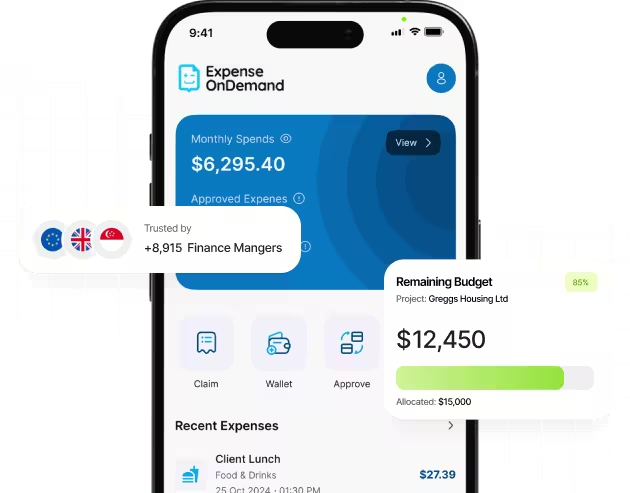
ExpenseOnDemand helps employees track trips, calculate mileage expenses using predefined rates and submit claims through customised approval workflows. Finance teams can review mileage alongside other travel expenses, query claims and retain control over approval.
As rates change, review your mileage settings, communicate your reimbursement policy and ensure employees understand the difference between business travel and commuting.
Explore ExpenseOnDemand to simplify mileage tracking and expense approvals.
%201.png)