
Manual expense management rarely fails outright, instead, it quietly drains time, money, and focus through hidden inefficiencies and reactive controls. By shifting expense governance upstream, organisations can prevent issues before they occur, reduce operational drag, and enable finance teams to move from firefighting to strategic decision-making.
Key Takeaways
Most expense processes don’t fail, and that’s precisely the problem.
Expenses are submitted, finance teams review them, employees are reimbursed, and the business moves on. Nothing breaks, no alarms are triggered, and there’s no obvious catalyst forcing change. From the outside, the process appears to be doing its job.
But this surface-level functionality is exactly how manual expense management quietly becomes one of the most expensive operational systems in the business.
When processes “work,” inefficiencies are tolerated rather than questioned.
Time spent chasing receipts, re-keying data, resolving errors, and approving claims becomes accepted as part of normal operations, even though it compounds week after week.
Manual processes rarely create a visible crisis. Instead, they create drag; small, persistent inefficiencies that slow teams down, increase administrative overhead, and divert focus away from higher-value work.
This drag doesn’t appear as a single line-item overspend on the P&L, which makes it far harder to spot. Yet over time, it silently erodes productivity, inflates costs, and limits the organisation’s ability to scale efficiently.
The true cost of manual expense management doesn’t appear as a single number. It fragments across time, attention, and decision-making quality.
It shows up in:
Individually, none of these issues look severe enough to justify change.
Collectively, they create an environment where finance operates reactively.
Always correcting, rarely steering.
Manual expense management pushes financial governance to the very end of the process.
Controls are applied only after expenses are submitted, policies are enforced after the spend has already occurred, and issues are identified only once decisions have been made.
At that point, finance teams are no longer guiding behaviour, they are reacting to it.
By the time finance intervenes, the context around the expense is often lost. The employee has moved on, receipts are incomplete or unclear, and approvals become a back-and-forth exercise that consumes time on both sides. Each query, correction, or policy exception increases the cost of processing that expense, turning what should be a routine task into a drain on productivity.
This is not a failure of skill, diligence, or effort within finance teams.
It’s a structural issue.
When governance is applied after the fact, finance is forced into a policing role (reviewing, questioning, and fixing) rather than operating strategically. Instead of focusing on spend optimisation, forecasting, and financial insight, teams remain stuck in reactive firefighting, managing problems that could have been prevented earlier in the process.
The solution to inefficient expense management isn’t reviewing claims faster or adding more resources to the same broken process. Speeding up manual reviews only masks the underlying issue. Real improvement comes from redesigning where control lives within the expense workflow.
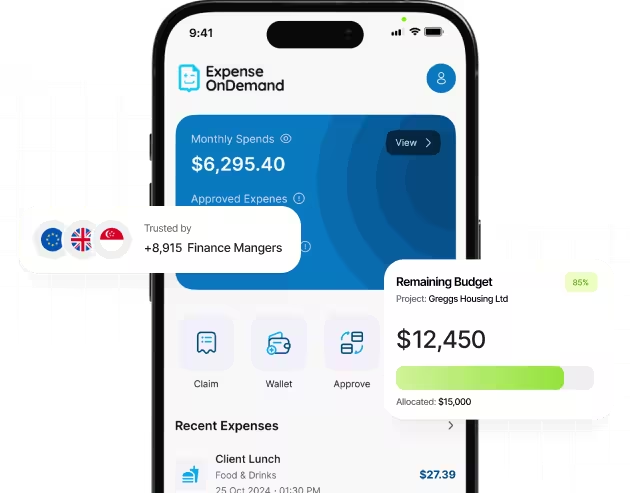
At Expense On Demand, expense management is treated as an upstream control problem, not a downstream reconciliation exercise. Instead of relying on finance teams to catch issues after the fact, controls are built directly into the point where decisions are made. Policy logic is applied at the moment an expense is submitted, real-time validation replaces post-approval corrections, and approval workflows are aligned to risk rather than rigid organisational hierarchy.
This structural approach ensures clean, consistent, and fully compliant data flows directly into finance and ERP systems without manual intervention. When issues are prevented rather than corrected, finance teams spend less time fixing errors and more time delivering insight.
The result is a more resilient financial system. A system that scales efficiently, reduces risk, and supports smarter decision-making across the business.
The outcome of modern expense management isn’t just greater efficiency, it’s clarity.
When expense data is captured correctly at the source, finance teams gain a clean, consistent view of spend they can genuinely trust. Month-end closes happen faster with fewer adjustments, forecasts are built on reliable inputs rather than assumptions, and financial insight improves because the underlying data is sound.
This shift allows finance teams to move away from correction and control, and toward analysis and strategic guidance.
Time once spent querying claims and fixing errors is redirected into understanding trends, managing risk, and supporting better decision-making across the organisation. Ultimately, the most expensive expense process isn’t the one that breaks. It’s the one that appears to work, while quietly draining time, confidence, and decision quality across the business.
%201.png)